
Searching for a fertility nutritionist in the USA usually starts with one frustration. You have a doctor, maybe a fertility clinic, and a pile of conflicting advice about food. Nobody has told you what to put on your plate this week.
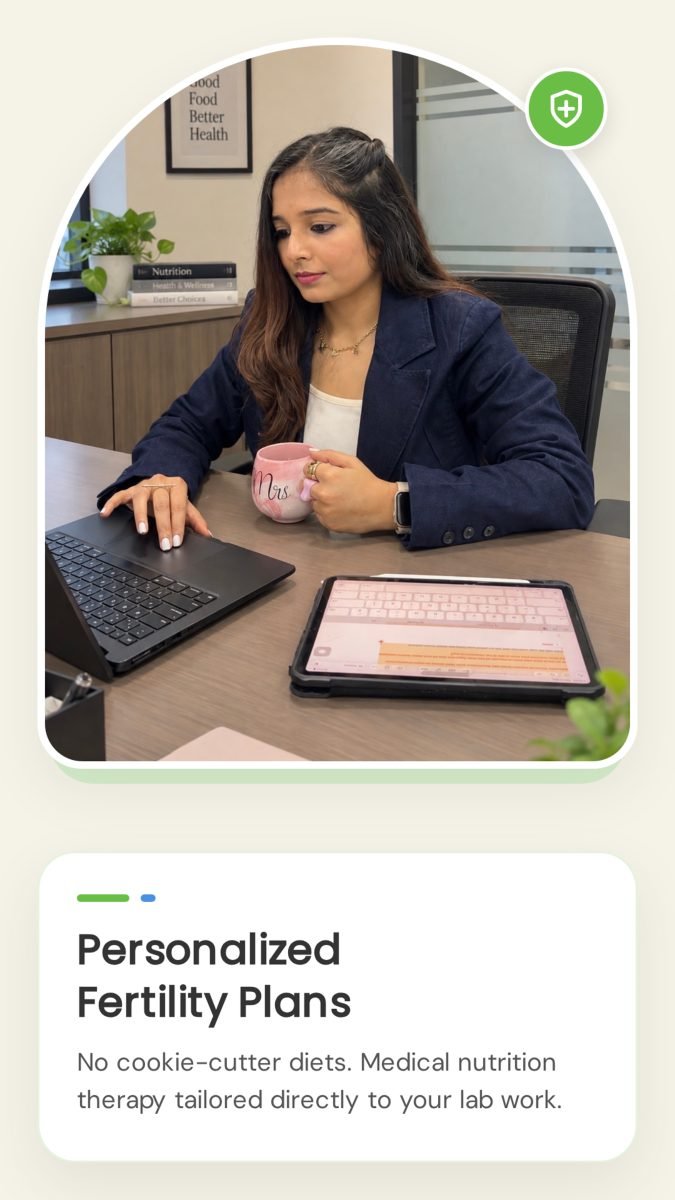
Health Hatch is an online fertility nutrition practice. Our registered dietitians in India support clients in the United States by video or audio call. Their plans are built around your reports, routine and the foods you actually eat.
Explore fertility programs | Complete the fertility assessment
Quick answer: what does a fertility nutritionist do? A fertility nutritionist builds a personalized eating and lifestyle plan around your medical history, blood work and treatment. The aim is to support your general, metabolic and preconception health. Nutrition cannot guarantee pregnancy or replace medical care, but it can help you prepare well alongside it.
Table of contents
- Fertility Nutritionist USA: who we are and how online support works
- What makes Health Hatch different
- Personalized grocery lists for US stores
- Fertility nutritionist USA support for Indian couples
- Support for your fertility journey
- Egg freezing nutrition
- Our four fertility programs
- How to get started
- FAQs
Fertility Nutritionist USA: who we are and how online support works
Health Hatch was founded by dietitians with more than 13 years of experience in nutrition and clinical practice. Our registered dietitians in India have supported clients across 60 countries.
Consultations take place online, so you can work with us from any US state. We offer sessions across US time zones, subject to scheduling availability.
An important note on credentials. Our dietitians are registered in India. They are not US-credentialed or US-licensed dietitians, and we do not operate a US clinic or bill US insurance.
We work alongside your doctor, never in place of them. Your fertility specialist or OB-GYN stays in charge of diagnosis, medication and treatment.
What makes Health Hatch different
A generic fertility diet cannot account for your blood work, your treatment plan or your kitchen. Our plans therefore start with you.
We build support around:
- Your medical history and current fertility treatment
- Your blood reports, including thyroid, glucose, insulin, vitamin D and iron markers
- Conditions such as PCOS (polycystic ovary syndrome), thyroid disease and insulin resistance
- Low AMH, anti-Müllerian hormone, which is a marker of ovarian reserve (how many eggs remain)
- Male fertility, including semen analysis results
- Your food culture, vegetarian or non-vegetarian preferences and religious customs
- Your routine, including shift work, travel and cooking time
- Sleep, exercise and stress, because they affect metabolic health too
Most importantly, the plan has to be sustainable. A plan you cannot follow in a busy week does not help you.
Personalized grocery lists for US stores
Many people can eat well but struggle to turn advice into a shopping cart. For this reason, we spend real time on groceries with our US clients.
Your dietitian helps you build a personalized grocery list based on the stores you use. That might be Walmart, Costco, Target, Kroger, Whole Foods Market, Trader Joe's, a local Indian grocer or an online Indian grocery service. We have no affiliation with any retailer, and product availability varies by store and region.
What a personalized grocery list covers
- Label reading. How to check protein, fiber, added sugar and sodium on packaged foods.
- Budget. Where to buy in bulk and which items are worth the extra cost.
- Eating out and takeout. How to order well at restaurants and from delivery apps.
- Packaged foods. Which convenience items fit your plan and which do not.
We do not prescribe one universal fertility shopping basket. Instead, your list reflects your reports, preferences and household.
Adapting Indian meals with US ingredients
| Familiar Indian food | US-friendly options to discuss with your dietitian |
|---|---|
| Dal and lentils | Dried or canned lentils, split peas, mung beans |
| Chana and rajma | Canned or dried chickpeas and kidney beans |
| Paneer | Paneer from Indian grocers, or firm tofu as a vegan swap |
| Dahi (yogurt) | Plain Greek or regular yogurt without added sugar |
| Roti and rice | Whole wheat atta, brown or basmati rice, millets, oats |
| Sabzi | Fresh or frozen vegetables, including leafy greens |
| Snacks | Nuts, seeds, fruit, roasted chana |
| Non-vegetarian protein | Eggs, fish, chicken, depending on your preferences |
Frozen vegetables and canned beans are practical, nutritious options for busy weeks.
Fertility nutritionist USA support for Indian couples
Many Indian women and couples in the USA tell us the same thing. Generic advice assumes a Western diet, while advice from home assumes Indian groceries and family cooking.
We understand both. For example, a plan can keep your dal, sabzi and roti while adjusting portions, protein and carbohydrate quality. It can also work around festival foods, fasting days, a vegetarian household or a partner who eats differently.
However, our fertility nutritionist USA support is not only for Indian clients. We support any US resident who wants online fertility nutrition guidance, and we adapt plans to whatever foods and traditions you follow.
Support for your fertility journey
Trying to conceive naturally
Nutrition for natural conception centers on regular meals, adequate protein, fiber, and a healthy pattern of folate, iron and vitamin D. Folic acid supplementation is recommended before pregnancy in the USA. [1] ASRM notes that healthy lifestyle habits are part of optimizing natural fertility. It also advises evaluation after 12 months of trying under age 35, or 6 months at 35 and over. [2] Our natural conception support is covered in more depth in our natural conception diet guidance.
IVF and IUI
Treatment brings its own questions about protein, blood sugar and what to eat around stimulation, retrieval and transfer. Nutrition complements your clinic's protocol and does not change it. Read more about IVF nutrition support, or our online fertility nutritionist service.
PCOS, thyroid and insulin resistance
These conditions affect ovulation, hormones and metabolic health. Nutrition is a central part of managing them, alongside medical care. [3] [4] Explore our pages on PCOS, thyroid health and insulin resistance.
Low AMH and egg quality
AMH is a marker of ovarian reserve. No diet has been shown to raise AMH or ovarian reserve. [5] Nutrition can still support your overall health and treatment preparation, but we do not promise changes to egg quality.
Male fertility
Semen analysis and a medical assessment come first. Nutrition and lifestyle may support sperm health alongside that care, although evidence for specific interventions is limited. [6] See our male fertility nutrition support.
Egg freezing nutrition
Egg freezing, or oocyte cryopreservation, involves hormone injections followed by an egg retrieval. Many women want to prepare their health beforehand.
We can help you review your nutrition, blood work, sleep, exercise and stress habits in the weeks before a cycle. We can also support you through stimulation with practical meal ideas. Our guide to egg freezing nutrition goes deeper.
To be clear, nutrition does not promise better egg quality, a higher number of eggs retrieved or improved ovarian reserve. Those outcomes depend mainly on age, ovarian reserve and your medical protocol.
Our four fertility programs
Health Hatch offers four fertility programs designed for different needs and stages. Some suit someone just starting out. Others suit couples who want closer, ongoing support.
Compare all four fertility programs to see what each includes, then view program pricing.
Not sure which fertility program is right for you? Book a free 15-minute discovery call with our team. We can help you understand the available options and identify the program that may best suit your needs.
Book a free 15-minute discovery call
How to get started
- Take the assessment. Complete the fertility assessment so we understand your situation.
- Choose a program. Compare options, or talk to us on a discovery call.
- Meet your dietitian online. Share your reports, routine and food preferences.
- Receive a personalized plan. It includes meal guidance and a grocery list for your US stores.
- Follow up as you go. Adjust the plan as your treatment or circumstances change.
FAQs
Can I work with an Indian dietitian if I live in the USA?
Yes, for online nutrition guidance. Our dietitians are registered in India and are not US-licensed, and we do not offer US insurance billing. Your US doctor remains responsible for your medical care.
Do you offer appointments in US time zones?
We offer online sessions across US time zones, subject to scheduling availability. Share your location when you enquire, and we will confirm what times are available.
Will my plan use food from US grocery stores?
Yes. We build your plan and grocery list around the stores you use, such as Walmart, Costco, Target, Kroger, Whole Foods Market, Trader Joe's or Indian grocers. Availability varies by location.
Can diet increase AMH or improve egg quality?
No diet has been shown to reliably raise AMH or ovarian reserve. Nutrition supports your overall health and treatment preparation, but it does not promise changes in egg quality.
Is your support only for Indian couples?
No. We understand Indian food and family patterns well, but we support any US resident seeking online fertility nutrition guidance.
Can you support me during IVF, IUI or egg freezing?
Yes. We work alongside your clinic and never change your medication or protocol. Nutrition complements treatment and cannot guarantee a cycle outcome.
Do you also support male partners?
Yes. We can review semen analysis results and lifestyle alongside your partner's doctor's advice. Nutrition is only one part of male fertility care.
Will working with Health Hatch guarantee pregnancy?
No. Fertility depends on many factors, including age, diagnosis and treatment. We aim to help you prepare as well as you can, and we cannot promise an outcome.
Ready to talk to a fertility dietitian?
If you want fertility nutritionist USA support built around your reports, culture and US kitchen, start with a conversation.
- Speak with a Health Hatch dietitian
- Complete the fertility assessment
- View fertility program pricing
- Book a free 15-minute discovery call
References
- US Preventive Services Task Force. Folic acid supplementation to prevent neural tube defects: recommendation statement. JAMA. 2023. doi:10.1001/jama.2023.12876
- Practice Committee of the American Society for Reproductive Medicine. Optimizing natural fertility: a committee opinion. Fertil Steril. 2022. doi:10.1016/j.fertnstert.2021.10.007
- Teede HJ, et al. Recommendations from the 2023 international evidence-based guideline for PCOS. J Clin Endocrinol Metab. 2023. doi:10.1210/clinem/dgad463
- Alexander EK, et al. 2017 guidelines of the American Thyroid Association for thyroid disease during pregnancy and the postpartum. Thyroid. 2017. doi:10.1089/thy.2016.0457
- Practice Committee of the American Society for Reproductive Medicine. Testing and interpreting measures of ovarian reserve: a committee opinion. Fertil Steril. 2020. doi:10.1016/j.fertnstert.2020.09.134
- Schlegel PN, et al. Diagnosis and treatment of infertility in men: AUA/ASRM guideline part I. Fertil Steril. 2021. doi:10.1016/j.fertnstert.2020.11.015
This article is general education, not personal medical advice. Health Hatch provides nutrition education and personalized dietary guidance. It does not diagnose conditions or replace care from your doctor or fertility specialist. Speak to your doctor or dietitian about your own situation. Individual outcomes vary.