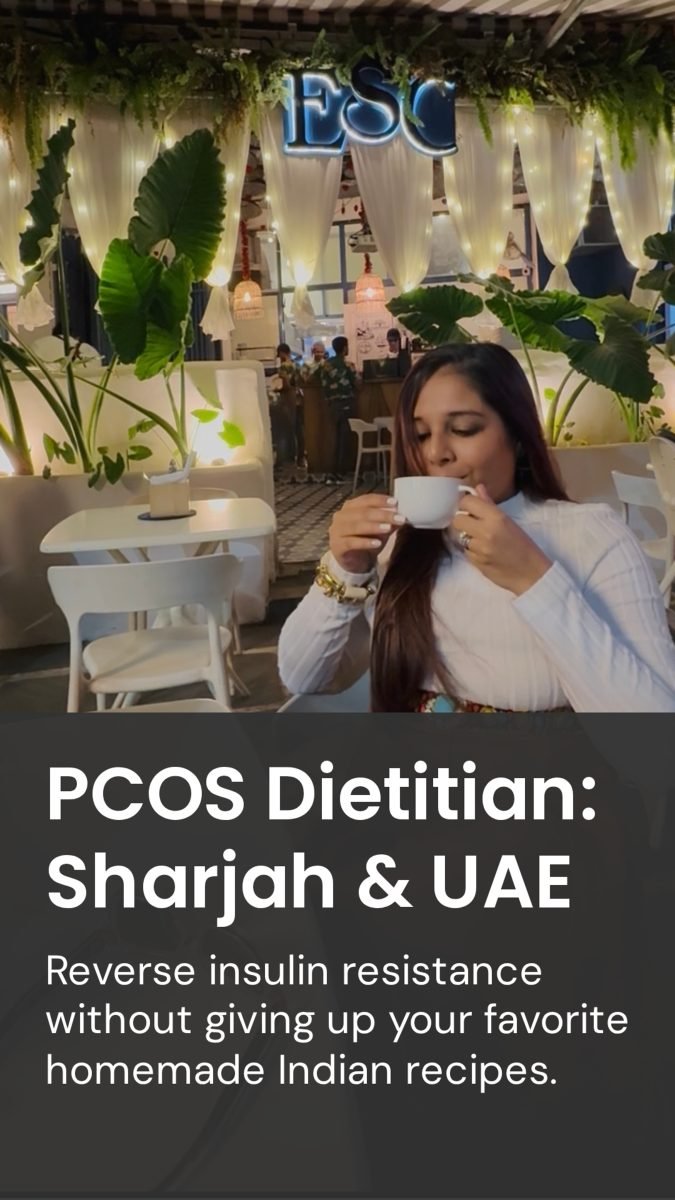
If you're a woman living in Sharjah, your day may start in traffic before sunrise and end with dinner on the table well after 8 — with a home-cooked meal when there's time, a cafeteria karak and sandwich on the way, a desk lunch in Dubai, and a Talabat order on the nights you're simply too tired to cook. Whether you're Emirati, from elsewhere in the Arab world, from South Asia, the Philippines, Africa, Europe, or anywhere else, most PCOS/PMOS advice you'll find online wasn't written for this life. Add hours on the road, short nights, summers too hot to walk outdoors, and one of the highest rates of diabetes in the world, and a generic "cut carbs and lose weight" leaflet rarely helps. If you're between 30 and 45, living in Sharjah, and looking for personalised, evidence-based PCOS/PMOS nutrition support online — whether you're dealing with irregular cycles, insulin resistance, weight changes, skin and hair symptoms, or fertility questions — here are 36 answers to help you decide what kind of support you need.
SECTION 1: About the Programme
Q1. What is Health Hatch's online PCOS/PMOS nutrition programme for women in Sharjah?
A fully online, personalised nutrition programme for women with PCOS/PMOS, built around your cycle history, symptoms, blood results where available, and the way you actually eat and live in Sharjah. It includes a personalised meal plan, ongoing WhatsApp support, and regular check-ins as your cycle, symptoms, and results change.
Q2. Who are the dietitians, and are they licensed in the UAE?
Our team are qualified dietitians registered in India, with 13+ years of clinical experience in PCOS/PMOS, hormonal health, fertility, and metabolic conditions, supporting 10,000+ clients across 60+ countries. We are not licensed by the UAE Ministry of Health and Prevention (MOHAP) or any other UAE health authority, so our role is nutrition consultation that works alongside — never instead of — your gynaecologist, endocrinologist, GP, or fertility clinic, who remain responsible for your diagnosis and medical care.
Q3. Will the plan work with my food, whatever my background?
Yes — that's the point of a personalised plan. Sharjah is home to women from dozens of countries, and we build your plan around the food you actually eat: Emirati and Gulf dishes like machboos, harees, balaleet, and saloona; Levantine and Egyptian food like ful, falafel, hummus, and koshari; South Asian meals with rice, roti, and dal; Filipino rice-and-ulam meals; African and Western-style breakfasts, salads, and sandwiches. Plans can be vegetarian, vegan, eggetarian, Jain, pescatarian, or non-vegetarian — all of them halal-friendly where needed — and dairy-free or gluten-free where there's a medical reason for it.
Q4. How does an online programme fit around a UAE working day?
Consultations take place over audio calls, with WhatsApp support in between — no need to find a quiet spot for a video call. The UAE is just 1.5 hours behind India all year round, with no daylight saving changes, so our working hours almost fully overlap with yours. Early-morning slots before work, lunchtime slots, and evening slots after work all fit easily, and our schedule adjusts during Ramadan, when working hours in the UAE change. Because it's fully online, there's no extra drive to fit into your week.
Q5. What programme options and pricing are available for clients in the UAE?
Q6. Do you provide WhatsApp support in Sharjah?
Yes — almost everyone in the UAE already uses WhatsApp, and it works the same for your plan. You can message with questions about a family lunch, an office iftar, a wedding, a weekend trip, a holiday back home, symptom changes, and cycle tracking between consultations.
SECTION 2: Understanding PCOS/PMOS
Q7. Is Health Hatch the "best" online PCOS/PMOS dietitian in Sharjah?
"Best" depends on fit. What matters is whether a nutrition professional treats PCOS/PMOS as the varied condition it is, looks at your own history and results, understands the food you actually eat, and gives you a plan you can keep up with — rather than a generic list of foods to avoid. Many of our clients have seen improvements in cycle regularity and symptoms, but no dietitian, including us, can promise the same outcome for every woman.
Q8. What is PCOS/PMOS, in simple terms?
Polycystic ovary syndrome (PCOS) — also referred to as PMOS, polycystic metabolic ovary syndrome, to reflect its metabolic side — is a common hormonal condition. In the UAE it's usually diagnosed by a gynaecologist or endocrinologist using the Rotterdam criteria, which look for at least two of three features: irregular or absent ovulation (often seen as irregular periods), signs of higher androgen levels (such as excess facial hair, acne, scalp hair thinning, or raised testosterone on a blood test), and polycystic-appearing ovaries on ultrasound. Not every woman has all three.
Q9. Does my ethnic background change how PCOS/PMOS shows up?
It can. Research suggests PCOS/PMOS can look different across ethnic groups. Women of South Asian heritage, for example, tend to have more insulin resistance at a similar body size than women of white European heritage, and studies from the Gulf region have found high rates of insulin resistance and other metabolic risk factors in women with PCOS/PMOS. Symptoms like excess hair growth can also vary in how noticeable they are. This is why your plan starts with your own history, symptoms, and blood results rather than a template.
Q10. I'm not overweight. Can I still have PCOS/PMOS and insulin resistance?
Yes. Many women with PCOS/PMOS have a BMI in the "healthy" range but still carry more weight around the middle, and may have insulin resistance or raised blood sugar markers. This is sometimes called "lean PCOS/PMOS," and it's easy to overlook if the only advice given is to lose weight. In these cases the focus shifts from weight loss to meal composition, protein, strength training, sleep, and metabolic markers.
Q11. Can PCOS/PMOS symptoms change after 30 — or with life in Sharjah?
Yes to both. Cycles, skin, weight, energy, and metabolic markers can shift again in your 30s and 40s — sometimes after years of feeling that your PCOS/PMOS was "under control," and sometimes after stopping the pill or after pregnancy. Life in Sharjah can play a part too: long daily commutes to Dubai, less time to cook and sleep, eating in the car or at your desk, summer heat that limits outdoor walking, and — if you've moved here — the stress of building a life away from family.
SECTION 3: PCOS/PMOS Diet — Food & Life in Sharjah
Q12. What is the best PCOS/PMOS diet for women in Sharjah?
There's no single "best" PCOS/PMOS diet — the international evidence-based PCOS/PMOS guideline doesn't favour one specific diet over another, and the right approach depends on your symptoms, metabolic markers, and preferences. For most women, the most useful changes aren't about cutting out whole food groups, but about the balance on the plate: more protein and vegetables, fewer refined carbohydrates and sugary drinks, and portions that match your activity levels — which, in a UAE summer, are often lower than you think.
Q13. Rice is at the centre of most of my meals. Do I have to give it up?
No. Whether it's machboos, biryani, rice and fish curry, or a plate of rice with adobo, rice is part of daily life for most families in Sharjah, and a plan that bans it rarely lasts. Instead, we work on the portion and the plate: a measured portion of rice, more of the chicken, fish, meat, or lentils, a generous salad or cooked vegetables alongside, and swaps on some days — such as brown or red rice, bulgur, freekeh, quinoa, or millets.
Q14. I don't have time to cook — or a housekeeper does most of the cooking. Can the plan still work?
Yes. Your plan includes simple one-pot recipes built around your schedule, so you can get a balanced meal from a single pot instead of several separate dishes — think a chicken-and-vegetable freekeh, a lentil and vegetable soup with grilled fish, a chickpea-and-spinach stew, or a vegetable-and-lentil khichdi with yoghurt. Most can be batch-cooked at the weekend and portioned into containers for work lunches. If a housekeeper or family member cooks for your household, we can give clear, practical instructions — portion sizes, cooking methods, and how much oil, ghee, and rice to use — that they can follow for the whole family.
Q15. Which foods available in Sharjah work well in a PCOS/PMOS plan?
Plenty. Grilled hammour, sheri, kingfish, and chicken; eggs; laban, Greek yoghurt, and labneh; hummus, ful medames, and lentil soup; fattoush, tabbouleh, and salads; lentils, chickpeas, and beans; nuts and seeds; frozen vegetables and berries; and wholewheat or multigrain bread — all easy to find at Lulu, Safari, Sharjah Co-op, Nesto, Carrefour, and specialist grocers across Sharjah. Even a takeaway shawarma or a mixed grill can fit, with the right sides. Your plan is adjusted to your own metabolic profile rather than applied identically to everyone.
Q16. I'm vegetarian. How do I get enough protein?
This is one of the most common gaps we see. Many vegetarian diets rely heavily on carbohydrates, with one small source of protein. We help you build protein into every meal using laban, Greek yoghurt, labneh, cheese, paneer, eggs if you eat them, tofu, lentils, chickpeas, ful, beans, soya, and practical options for busy days. Vegetarian and vegan women should also discuss vitamin B12 with their doctor, as low levels are more common without animal foods.
Q17. I leave home early and get back late from Dubai. How do I eat well on a long commute?
This is one of the most common challenges we hear from women in Sharjah. When you're on the road before 7 and home after 8, breakfast gets skipped, lunch becomes whatever's near the office, and dinner turns into a late takeaway. We help you plan a commute-proof day: a protein-rich breakfast you can eat in the car or at your desk, packed lunches from your weekend batch-cook, a sensible snack for the drive home so you don't arrive starving, and a lighter dinner even when you eat late. We also give practical guidance on Talabat and Noon Food orders, cafeteria karak-and-paratha stops, and Indian takeaways.
Q18. What about karak, Arabic coffee, dates, juices, and sweets?
You don't need to give them up. The goal is a pattern you can live with, not elimination. We look at how many cups of sweet karak or tea, handfuls of dates, juices and soft drinks, and sweets like luqaimat, kunafa, basbousa, or your own favourites from home actually fit into your week, and find a realistic balance — for example, gradually reducing sugar in tea, swapping sugary drinks for water, laban, or sparkling water, pairing dates with nuts or laban, and planning for sweets rather than feeling guilty about them.
Q19. How do I manage Eid, weddings, festivals, and family gatherings?
Between Eid al-Fitr and Eid al-Adha, iftar and Ramadan gatherings, the Sharjah Light Festival and winter events, weekend family lunches, Diwali, Onam, Christmas, and New Year parties, visiting family, and holidays abroad, it's easy for a plan to slip for weeks. Hospitality in the UAE is generous, and saying no to a second helping can feel rude. We plan ahead for these periods — what to eat before an event, how to manage sweets, fried food, and buffet spreads without restriction, and how to get back on track afterwards without a punishing "detox."
Q20. I fast during Ramadan or observe other fasts. Can the plan accommodate this?
Yes — and for Ramadan we plan for the whole month, not just the fast. Iftar tables often start with dates, Vimto or juices, and fried foods like sambousek, and late-night gatherings can add another full meal, so blood sugar and energy can swing a lot. We help you plan suhoor, iftar, and late-evening meals that respect your fast while keeping protein, fibre, and hydration in place — especially important when Ramadan falls in the hotter months. Even if you don't fast yourself, Ramadan in the UAE changes work hours, meal timings, and social plans, so we adjust your plan for that month too. We also support other fasting practices, such as Lent, Navratri, or Ekadashi. If you take medication such as metformin, check with your doctor before fasting.
SECTION 4: Insulin Resistance, Diabetes Risk & Lifestyle in Sharjah
Q21. Does insulin resistance cause PCOS/PMOS?
Not exactly. Insulin resistance and higher insulin levels are common in PCOS/PMOS and may contribute to symptoms in some women, but PCOS/PMOS isn't simply "caused by" insulin resistance, and not every woman with PCOS/PMOS has it.
Q22. Why does diabetes and heart health risk matter so much for women with PCOS/PMOS in the UAE?
The UAE has one of the highest rates of type 2 diabetes in the world, and PCOS/PMOS adds to that risk. Your background matters too: people of South Asian heritage, for example, tend to develop type 2 diabetes at a younger age and at lower body weights, which is why the World Health Organization has suggested lower BMI action points for Asian populations — around 23 as the point where health risk rises, and 27.5 as high risk. Whatever your background, it's worth making sure your HbA1c or fasting glucose and cholesterol are checked regularly, for example at your annual health check.
Q23. Can PCOS/PMOS-related insulin resistance improve with diet?
For many women, structured nutrition alongside regular movement — especially strength training — and good sleep can support insulin sensitivity. It's assessed and addressed individually, rather than assumed to apply to everyone with PCOS/PMOS.
Q24. Do I need to lose weight to manage PCOS/PMOS?
Not necessarily. Weight isn't the only goal — insulin sensitivity, cycle regularity, energy, and long-term heart and metabolic health can improve at different body sizes. Where weight loss is relevant, even a modest change of around 5% of body weight has been associated with improvements in PCOS/PMOS symptoms for some women.
Q25. How do long commutes, desk jobs, and the summer heat affect PCOS/PMOS?
They can all play a part. Hours in traffic, long sitting hours, skipped breakfasts, late dinners, short nights, and the stress of managing work, a home, and sometimes children can affect appetite, cravings, and blood sugar. From roughly May to September, the heat also makes outdoor walking difficult for months at a time — so step counts often drop sharply without women noticing. Your plan is built around your real schedule — including shifts and early starts — with practical movement ideas that fit around it, from short home workouts on busy weekdays and mall walks in summer to Al Majaz Waterfront and Al Qasba in the cooler months.
Q26. Should I be thinking about vitamin D living in the UAE?
Yes — even with year-round sunshine. Vitamin D deficiency is very common in the UAE, because most people avoid the midday sun, spend long hours in air-conditioned offices, cars, homes, and malls, and many cover their skin. Darker skin also makes less vitamin D from sunlight, and low vitamin D is common in women with PCOS/PMOS. Ask your doctor whether testing or a supplement makes sense for you.
SECTION 5: PCOS/PMOS & Fertility for Women 30–45 in Sharjah
Q27. Does PCOS/PMOS mean I can't get pregnant?
No. PCOS/PMOS is one of the most common causes of irregular ovulation, which can mean conception takes longer for some women, but it does not mean infertility. Many women with PCOS/PMOS conceive naturally; others benefit from medical treatment, sometimes alongside nutrition support.
Q28. I'm over 35 with PCOS/PMOS and trying to conceive. Does the diet change?
Age becomes more relevant to egg quality after 35, so overall diet quality, omega-3 sources (oily fish such as salmon, sardines, or mackerel, or walnuts, flax, and chia seeds for vegetarians), antioxidant-rich foods, and metabolic health tend to be emphasised alongside your existing PCOS/PMOS management. International guidance is to seek a fertility evaluation after 6 months of trying if you're 35 or older, and sooner if your periods are irregular or you're over 40.
Q29. Can nutrition help me prepare for IVF in the UAE or abroad?
Supporting your overall nutritional and metabolic health may help create a better foundation going into treatment, but it doesn't replace medical care and can't guarantee outcomes. It's also practical: IVF coverage depends heavily on your insurance plan, many standard plans don't cover it, and some clinics have BMI criteria before starting treatment. Many women in Sharjah choose between fertility clinics in Sharjah and neighbouring Dubai. Some women also choose treatment in their home country. Wherever you're being treated, we can support your nutrition before and during the process, working alongside your fertility clinic. Because fertility is a shared journey, couples preparing together can also choose our Conceive Together plan, which supports both partners' nutrition.
Q30. What about folic acid and preconception supplements?
World Health Organization guidance recommends 400 micrograms of folic acid daily, ideally starting before you try to conceive and continuing until 12 weeks of pregnancy. Women with a higher BMI, diabetes, or certain other risk factors may be advised by their doctor to take a higher dose — so it's worth asking your gynaecologist before you start trying. Vitamin D and, for vegetarians, B12 and iron are also worth discussing.
Q31. What blood tests are commonly relevant for PCOS/PMOS in the UAE?
Testosterone and other hormones, thyroid function, HbA1c or fasting glucose, cholesterol, and often vitamin D, B12, and ferritin (iron stores) are commonly discussed. Your gynaecologist, endocrinologist, or GP orders these — coverage depends on your insurance — and we help you understand what your results mean for your nutrition plan.
SECTION 6: Why Health Hatch & Our Programmes
Q32. Why should women in Sharjah with PCOS/PMOS choose Health Hatch?
Because you work with experienced dietitians, not a rotating team or an app — our fertility and Concierge Elite programmes are led personally by our co-founders, who have 13+ years of clinical experience in PCOS/PMOS, hormonal health, and fertility, and our other programmes by senior dietitians. Health Hatch is a women-led practice that has supported 10,000+ clients across 60+ countries over 10 years. Your plan is built from your own cycle history, symptoms, and blood results, designed around your food and your life in Sharjah, and adjusted every month as your body responds, with WhatsApp support in between. We also work alongside your doctors and specialists in the UAE rather than in place of them.
Q33. How has Health Hatch helped women with PCOS/PMOS? (Client stories)
Over the years, many of our PCOS/PMOS clients have seen meaningful changes with personalised nutrition support — more regular cycles, improvements in hormonal and metabolic blood markers such as insulin, glucose, and testosterone, and relief from symptoms like sugar cravings, fatigue, bloating, acne, and stubborn weight gain. Every woman's PCOS/PMOS is different, so results vary from person to person, and nutrition works best as one part of a wider care plan with your doctor. Many of our clients with PCOS/PMOS have also gone on to conceive naturally while following their plan — we never promise pregnancy, because conception depends on many factors beyond nutrition. Q34. How do the Transformation and Concierge Elite programmes help with PCOS/PMOS?
Transformation is our signature 3-month reset, designed to give your hormones and metabolism time to respond. It includes monthly calls with a senior dietitian, 6 custom diet plans that evolve with your cycle and symptoms, eating-out guidance for restaurants, cafeterias, and takeaways, 80 curated recipes, and everything in the Starter Plan — a blood report review, progress tracking, and WhatsApp support.
Concierge Elite is our most popular, white-glove programme. It includes 2 calls a month with a co-founder, 12 custom diet plans for faster fine-tuning, 350+ recipes, custom grocery lists for your Lulu, Safari, or Sharjah Co-op shop, a travel nutrition strategy for work trips and holidays, personalised supplement suggestions (coordinated with your doctor where needed), and everything in the Starter Plan. It suits women with busy, travel-heavy lives, more complex hormonal or metabolic profiles, or a fertility goal they want to prepare for carefully. Your complimentary onboarding call is the best place to decide which fits you.
SECTION 7: Getting Started in Sharjah
Q35. What should I look for before booking any online PCOS/PMOS dietitian or nutritionist?
Check their qualifications and where they're licensed, whether they do a proper intake (cycle history, symptoms, blood results) rather than a generic form, whether they understand the food you actually eat and don't simply tell you to stop eating it, and whether they offer ongoing follow-up. Be cautious of anyone selling a "cure," pushing expensive supplement bundles, or telling you to stop treatment your doctor has recommended.
Q36. How do I get started in Sharjah?
Enquire through our website, message us on WhatsApp at +91-8010749168, or email info@health-hatch.com. The programme is fully online, so you can start from anywhere in Sharjah — whether you're in Al Nahda, Al Taawun, Al Majaz, Al Khan, Muwaileh, Rolla, or anywhere in between.
Ready to Get Started?
Whether you're managing irregular cycles, insulin resistance, weight changes, or fertility plans alongside PCOS/PMOS, personalised nutrition can help you understand what's actually going on in your body — and give you a plan that fits your life in Sharjah, from the family table to the long drive to Dubai. Health Hatch works with women aged 30–45 across Sharjah, the wider UAE, and 60+ countries, alongside the care you receive from your doctors and specialists.
Want personalised support for your PCOS/PMOS nutrition? Enquire with our team.
Curious about programme structure and cost first? See current pricing.
This article is for general information and isn't a substitute for medical advice. Please speak with your doctor or specialist about your diagnosis, medication, fasting, and fertility treatment.