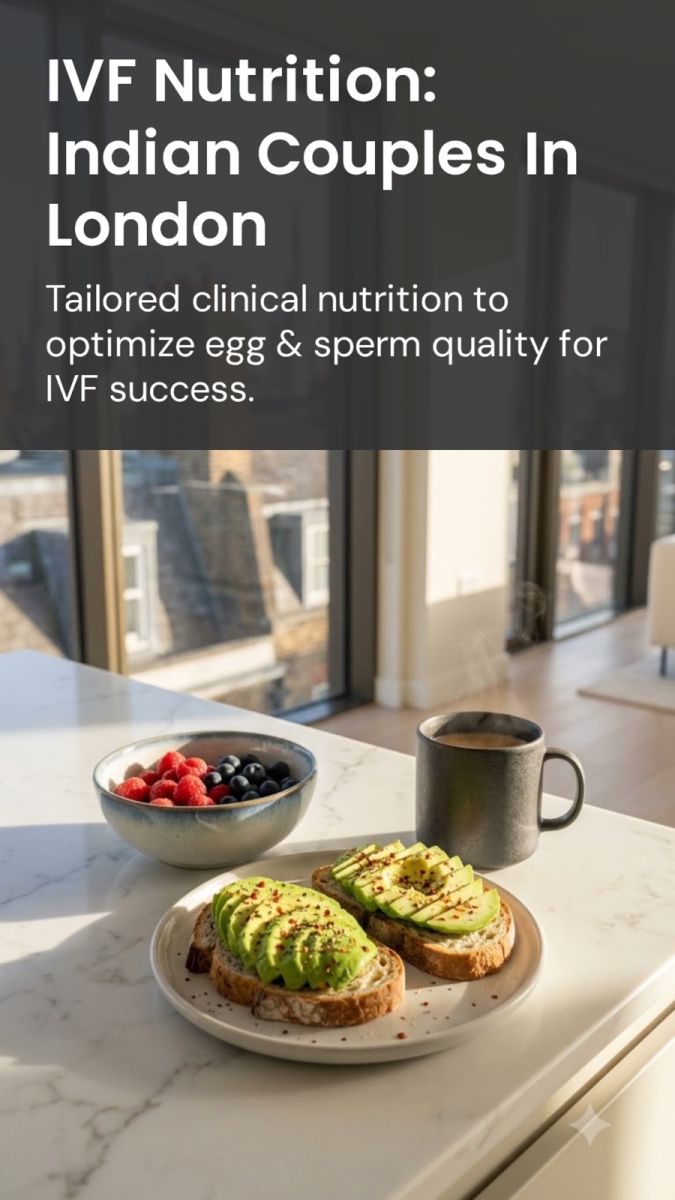
You've chosen your London clinic and maybe started injections. Then comes the advice: "eat a balanced diet." If you grew up on dal, roti and sabzi but now live on Tesco meal deals and late-night Deliveroo, that leaves a lot unanswered. Should you still eat rice? Is the London sky behind your low vitamin D? Why does your consultant mention your BMI when you don't feel overweight? Nutrition can't replace IVF, but it's one of the few parts of treatment you control.
Before you read on: take the Health Hatch Fertility Assessment to get your Fertility Assessment Score and see which factors below matter most for you.
Quick Answer
An IVF nutritionist for Indians in London adapts your diet to patterns common in South Asian people, such as insulin resistance at a lower BMI and frequent vitamin D, B12 and iron deficiency. No diet guarantees IVF success, but a healthy dietary pattern, good blood-sugar control and corrected deficiencies are associated with better reproductive health and may help both partners arrive at treatment in better condition.
In This Article
- Why do Indian couples in London need a different IVF nutrition approach?
- How can diet and lifestyle support hormones before IVF?
- What does an IVF-friendly Indian plate look like in the UK?
- What should you focus on at each stage of IVF?
- Why does the male partner's diet matter?
- How has Health Hatch helped Indian couples undergoing IVF?
- How does Health Hatch support Indian couples in the UK?
- How has Health Hatch helped couples like you?
- The Conceive Together programme (UK)
- FAQs
Why Do Indian Couples in London Need a Different IVF Nutrition Approach?
The Human Fertilisation and Embryology Authority (HFEA) reported that in 2020–21, Asian patients aged 18–37 had an IVF birth rate of around 24%, compared with 32% for White patients. The reasons aren't fully understood, and diet alone doesn't explain the gap. Several of the likely contributors, though, are metabolic and nutritional.
- Insulin resistance appears at a lower weight. NICE now uses lower BMI thresholds for South Asian adults (overweight from 23, obesity from 27.5) because metabolic risk rises earlier.
- PCOS tends to come with more insulin resistance in South Asian women, which can affect ovulation and the response to stimulation.
- Vitamin D deficiency is common. The NHS advises people of South Asian background to consider supplementing vitamin D all year round, not just in winter.
- B12 and iron gaps are frequent in vegetarian Indian diets and often go unnoticed until tested.
Practical takeaway: A "normal" BMI doesn't rule out metabolic and micronutrient issues worth correcting before IVF.
How Can Diet and Lifestyle Support Hormones Before IVF?
Eggs and sperm take roughly three months to mature, so the 90 days before a cycle matter most. The aim is to improve the hormonal and metabolic conditions they develop in.
| Hormonal / metabolic factor | Why it matters for IVF | Where nutrition may help |
|---|---|---|
| Insulin and blood sugar | High insulin can raise androgens and disrupt ovulation, particularly in PCOS | Protein at every meal, fibre-rich carbs, smaller portions of refined rice and maida |
| Thyroid function | Untreated dysfunction is linked to lower conception and higher miscarriage risk | Adequate iodine and selenium; correct medication timing around food |
| Inflammation and oxidative stress | May affect egg and sperm quality | Vegetables, pulses, nuts, seeds, oily fish; fewer ultra-processed foods |
| Vitamin D, B12, iron, folate | Common deficiencies relevant to conception | Food first, plus testing-led supplements |
The strongest dietary evidence for IVF comes from Mediterranean-style eating patterns. A 2023 meta-analysis found higher adherence was associated with better pregnancy and live birth rates in assisted reproduction, though the evidence is still preliminary. This is a pattern (vegetables, legumes, whole grains, healthy fats, fish), not a cuisine, and a well-planned Indian diet fits it closely.
Lifestyle matters too: regular movement, 7–8 hours of sleep, and avoiding alcohol and smoking, in line with NICE fertility guidance. With long commutes and late dinners, meal timing often needs as much attention as meal content.
What Does an IVF-Friendly Indian Plate Look Like in the UK?
You don't need to give up Indian food. Most of the time you need to rebalance it.
| Typical London-Indian habit | IVF-supportive adjustment |
|---|---|
| Large bowl of white rice with a thin dal | Half the rice, a thicker dal or rajma, plus a sabzi or salad |
| Toast or cereal on the way to the Tube | Besan chilla, moong dal dosa, Greek yoghurt with nuts and seeds, or eggs |
| Chai and biscuits at 4pm | Roasted chana, makhana, fruit with peanut butter |
| Fully vegetarian, dairy-heavy protein | Add tofu, tempeh, lentil pastas and edamame (all widely available in UK supermarkets) |
Meals don't have to be elaborate. An IVF-friendly meal doesn't need to be the full rice + dal + sabzi or roti + sabzi + dal spread every day. A one-pot meal works just as well when it combines a grain, vegetables and a protein:
- Rice bowl: rice, sautéed vegetables and rajma, chole or sprouts, with a spoon of curd
- Wrap: a wholewheat tortilla with paneer or chicken, peppers, onions and a sprout salad
- One-pot khichdi or pulao: rice or millet cooked with moong dal, mixed vegetables and peas
- Bean and vegetable stew: kidney beans or chickpeas with spinach and tomatoes, eaten with a tortilla or rice
Your meals also need to fit your schedule. If a plan means cooking three dishes after a 7pm finish, it won't last through a stressful IVF cycle. The best plan is easy and practical to follow, and doesn't add to your workload: batch-cooked, quick to assemble and made from ingredients you can find on your usual shop.
Practical takeaway: Aim for protein at every meal, fewer refined carbs and more colour on the plate, in meals simple enough to make on a busy weekday.
What Should You Focus On at Each Stage of IVF?
Your nutrition priorities shift as treatment moves along.
| IVF stage | Nutrition focus |
|---|---|
| 3 months before | Correct deficiencies, improve blood sugar, both partners start folic acid, vitamin D and a balanced diet |
| Ovarian stimulation | Enough protein and fluids; small, regular meals if you feel bloated |
| Egg retrieval | Hydration and easy-to-digest meals (khichdi, soups, curd rice) for recovery |
| Embryo transfer and two-week wait | Steady meals and food safety; avoid unpasteurised products and high-mercury fish |
The NHS recommends 400 micrograms of folic acid daily before conception, and some women are prescribed a higher dose. Check any supplement with your fertility clinic first.
Why Does the Male Partner's Diet Matter?
Male factor contributes to a significant share of infertility, and even IVF with ICSI depends on the sperm used. Systematic reviews associate diets rich in vegetables, fruit, fish, whole grains and nuts with better semen quality, and processed meat, sugary drinks and heavy alcohol with poorer parameters.
That's why we believe both partners should prepare together.
What nutrition can't do: guarantee IVF success, or reliably raise AMH or ovarian reserve. What it can do is support the metabolic and nutritional health you bring into treatment.
How Has Health Hatch Helped Indian Couples Undergoing IVF?
Over more than a decade and 10,000+ clients, many of them Indian couples living abroad, we've seen the same pattern. Couples who spend two to three months correcting what's modifiable tend to go into treatment in better shape. That means steadier blood sugar, corrected vitamin D and B12, a healthier body composition and a male partner who is preparing too. These are the factors associated with a better response to treatment, and they're where our work focuses.
A few examples from our clinical experience:
- Response to stimulation: a 42-year-old client with PCOS froze around 15–18 eggs after working on her metabolic health and nutrition before her cycle.
- Sperm parameters: a male partner's sperm concentration improved from around 11 to 17 million/mL over three months of nutrition and lifestyle changes alongside his medical care.
- Challenging diagnoses: a couple where she had low AMH and he had teratozoospermia went on to conceive naturally after working with us.
We share these to show the kind of change that's possible, not as a promise. Every couple's diagnosis, age and clinic protocol is different, and outcomes depend on many factors beyond nutrition. What we can offer is a structured way to give your body the best-prepared starting point for each IVF cycle.
How Does Health Hatch Support Indian Couples in the UK?
Generic UK diet plans rarely account for Indian eating patterns, and Indian plans rarely account for London life. Health Hatch's registered dietitians have 13+ years of clinical experience with clients in over 60 countries, and we bridge that gap for couples preparing for IVF in the UK.
- An Indian-style diet plan built around you: your eating style (vegetarian, eggetarian, Jain or non-vegetarian), likes and dislikes, work schedule and commute.
- A grocery (shopping) list based on UK stores: foods you can actually find at Tesco, Sainsbury's, Waitrose, Lidl or your local Indian grocer, so the plan is easier to follow and stick to.
- Hormonal and blood report review (vitamin D, B12, ferritin, thyroid, HbA1c) alongside your clinic's plan.
We work alongside your fertility consultant, never in place of them.
How Has Health Hatch Helped Couples Like You?
Over more than 10 years, Health Hatch has supported 10,000+ clients across 60+ countries, including many Indian families living abroad. A few examples from our fertility practice:
- Male factor: one male partner's sperm concentration improved from around 11 to 17 million/mL over three months while he worked on nutrition and lifestyle alongside his medical care.
- Low AMH and teratozoospermia: we worked with a couple where she had low AMH and he had a high proportion of abnormally shaped sperm. They later conceived naturally.
- Egg freezing at 42 with PCOS: one client froze around 15–18 eggs after working with us on her metabolic health and nutrition before her cycle.
These are individual client experiences, not evidence that nutrition alone caused the result. Fertility depends on many factors, and outcomes vary. What these couples had in common was a plan built around their reports, their food and their routine, followed consistently alongside their medical care.
How Can Conceive Together Support Your IVF Journey?
Our most popular programme for Indian couples preparing for IVF is Conceive Together (£699 for 3 months): one plan, both partners, one goal. IVF outcomes depend on both the egg and the sperm, and eggs and sperm take about three months to develop. That's why the programme prepares both partners over that same window.
| What's included | How it supports your IVF preparation |
|---|---|
| 2 joint calls a month with a co-founder and dietitian | Both partners are coached together and stay on the same page through the cycle |
| 6 cycle-synced plans for her | Meals matched to her cycle and treatment stage, built to support blood sugar and hormonal balance |
| 6 sperm-optimisation plans for him | Targets the diet and lifestyle factors associated with semen quality |
| Hormonal lab report review for both | Deficiencies and metabolic markers are picked up and addressed before the cycle |
| Supplement protocol for both | Evidence-based and checked against your clinic's protocol |
| Custom household grocery list | Based on UK stores, so one shop works for both of you |
| 80+ couple-friendly Indian recipes and WhatsApp support | Quick, practical meals and day-to-day help when questions come up |
Conceive Together can't guarantee IVF success, and nothing can. What it does is help both of you correct the modifiable factors linked to better treatment outcomes, in a way that fits your London life.
Looking for support for just one partner, or a monthly option? Compare all fertility programmes and UK pricing.
FAQs
Do I need an IVF nutritionist if my clinic already gives diet advice?
Not always, but it often helps. Clinic advice is usually brief and general. An IVF nutritionist turns your blood reports, eating pattern, schedule and conditions such as PCOS or thyroid disease into a daily plan built around the food you actually eat.
Can diet increase IVF success rates for Indian women?
No diet can guarantee IVF success. Healthy dietary patterns, better blood-sugar control and corrected deficiencies are associated with better reproductive outcomes in research. For South Asian women, who often develop insulin resistance at a lower BMI, addressing these before treatment may support a better response alongside the medical protocol.
How long before IVF should we change our diet?
Ideally about three months before your cycle, since eggs and sperm take roughly 90 days to mature. Shorter preparation still helps, particularly for blood sugar and correcting deficiencies.
Should Indian women stop eating rice before IVF?
No. What matters is portion and balance: pair a smaller serving with dal or another protein, vegetables and some fat to reduce blood-sugar spikes. Millets and brown rice add variety, but white rice isn't off-limits.
Why is vitamin D so often low in Indian people living in the UK?
The UK gets limited sunlight for much of the year, and darker skin makes less vitamin D from the same amount of sun. The NHS advises people of South Asian background to consider a vitamin D supplement all year. Ask your GP or clinic to test your level before treatment.
Can Health Hatch work with my London fertility clinic?
Yes. We work alongside your consultant's treatment plan, never in place of it. Consultations are online, so couples anywhere in London or the UK can join, and we review your clinic's blood reports as part of your plan.
Ready to Prepare for IVF With a Plan That Fits Your Life?
IVF asks a lot of you, physically, emotionally and financially. A plan built around Indian food, your London routine and your blood reports puts you in control of the part you can influence.
Start with your Fertility Assessment Score. Take the Health Hatch Fertility Assessment to find out which nutrition and lifestyle factors may matter most for you before IVF. Our fertility nutrition team will then help you work out whether Conceive Together is the right next step for you as a couple.
References
- Human Fertilisation and Embryology Authority. Latest ethnic diversity data highlights disparities in treatment outcomes (2023). hfea.gov.uk
- National Institute for Health and Care Excellence. Overweight and obesity management (lower BMI thresholds for South Asian, Chinese, other Asian, Middle Eastern, Black African and African-Caribbean adults).
- National Institute for Health and Care Excellence. Fertility problems: assessment and treatment (CG156).
- NHS. Vitamin D, and Planning your pregnancy (folic acid guidance). nhs.uk
- Winter HG, et al. Can dietary patterns impact fertility outcomes? A systematic review and meta-analysis. Nutrients. 2023;15(11):2589.
- Karayiannis D, et al. Adherence to the Mediterranean diet and IVF success rate among non-obese women attempting fertility. Human Reproduction. 2018;33(3):494–502.
- Salas-Huetos A, et al. Dietary patterns, foods and nutrients in male fertility parameters and fecundability: a systematic review of observational studies. Human Reproduction Update. 2017;23(4):371–389.
- Wijeyaratne CN, et al. Clinical manifestations and insulin resistance (IR) in polycystic ovary syndrome (PCOS) among South Asians and Caucasians: is there a difference? Clinical Endocrinology. 2002;57(3):343–350.